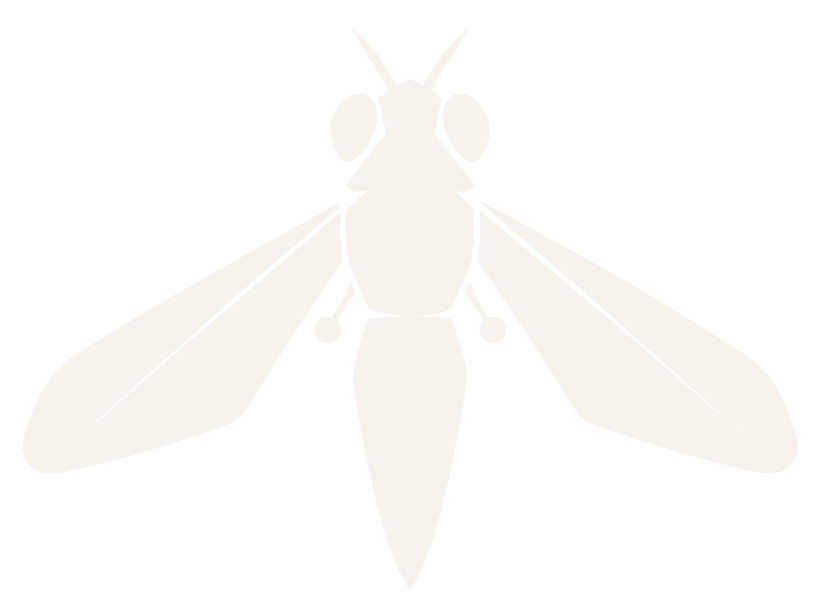
The Second Pair of Wings.
Why the company is named after the organ, not the wing — a short natural history of control.
Insects invented flight over three hundred million years ago, and most of them did it with four wings. Most of them still do: dragonflies, bees, butterflies, wasps. Four wings is the default plan. Four wings is more lift.
Flies gave two of them up.
The entire order is named for the sacrifice: Diptera, “two wings.” Somewhere in the deep past, the fly’s hindwings stopped being wings at all. They shrank into two club-shaped stalks that beat furiously against the wings’ rhythm and produce no lift whatsoever. To a casual observer they look vestigial — evolutionary clutter, leftovers on the way out.
They are the opposite. They are the reason the fly flies better than nearly everything that kept all four.
The organ that measures
The clubs are called halteres — the fly’s own gyroscopes. In flight they oscillate against the wingbeat (roughly two hundred times a second), and because a fast-vibrating mass resists changes to its plane of motion, they behave as gyroscopes. When the fly’s body rotates, the halteres twist against their sockets, and fields of sensors at their base read the strain and feed corrections straight to the flight muscles. Continuously. Without thinking, because there is no time to think.
Biologists proved what halteres do the direct way: remove them, and the fly can still beat its wings perfectly. It just can’t fly. It tumbles and falls within moments: full power, no reference frame. In the classic experiments, gluing a crude stabilizer to the abdomen restored flight. The power was never the problem. The orientation was.
And with orientation solved, the fly became one of the most maneuverable fliers on earth. High-speed cameras show flies beginning a banked escape turn within a handful of wingbeats of spotting a threat, which is why your hand almost never wins. Two wings plus instruments beat four wings, every day since the Triassic.
The same trade, refused
The software industry is currently running the fly’s experiment in reverse.
Models are wings, and everyone is building bigger ones: more capable models, more autonomous agents, more output per dollar. The lift is extraordinary and getting cheaper by the quarter. Meanwhile the enterprises those agents fly through remain what they have always been: thousands of systems, documents, APIs, regulations, workflows, and human decisions, all changing constantly, none of it written down anywhere an agent can trust.
The future of AI is not limited by intelligence. It is limited by orientation. Point the most advanced model in the world at a system it cannot sense, and you have a fly with its halteres removed — full power, no reference frame, tumbling at machine speed. The crashes are already in the news. They get bigger from here.
The organ we build
We named the company after the organ, not the wing — deliberately.
Haltere doesn’t build models, and doesn’t compete with the people who do. Models provide the intelligence; Haltere provides the control system. The map keeps agents oriented: where the system is, what has changed, what depends on what, what should happen next. The gates decide what may change. The receipt proves what did, and which human approved it.
Like its namesake, the layer generates no lift. Also like its namesake, it is the difference between speed and speed you survive: the thing that lets an organization turn its agents loose and still land every change exactly where it intended.
The metaphor is intentionally timeless. As models grow more powerful, the need for orientation only increases. Haltere is not another model competing for intelligence; it is the system that makes intelligence useful inside the real world.
The most important breakthroughs are rarely the largest or the most visible. They are the small, foundational systems that make everything else possible.
Flies learned that three hundred million years ago.
Let agents fly. Keep software under control.
— Haltere
Check us.
- Fraenkel & Pringle, “Halteres of Flies as Gyroscopic Organs of Equilibrium,” Nature 141 (1938): the ablation experiments, and flight restored with an artificial stabilizer.
- Pringle, “The gyroscopic mechanism of the halteres of Diptera,” Philosophical Transactions of the Royal Society B 233 (1948).
- Dickinson, “Haltere-mediated equilibrium reflexes of the fruit fly,” Phil. Trans. R. Soc. B 354 (1999).
- Muijres et al., “Flies evade looming targets by executing rapid visually directed banked turns,” Science 344 (2014).
- Deora, Singh & Sane, “Biomechanical basis of wing and haltere coordination in flies,” PNAS 112 (2015): wing–haltere anti-phase coupling.
- Etymology: Diptera, “two wings.”